
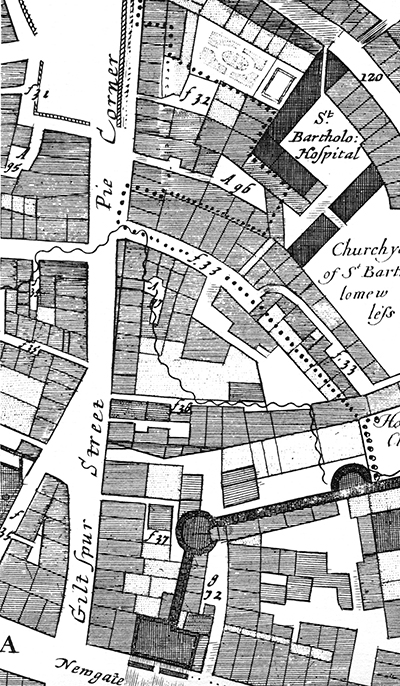
The Great Fire of London of September 1666 was said to have burnt itself out at Pie Corner. That name had long been in use for the upper part of Giltspur Street where it runs into West Smithfield – Py Corner appears on the Agas map of a century earlier. On the Ogilby and Morgan map shown here, a part of Smithfield appears as an open space at the top and the limit of the fire is marked by a wavy line, which wriggles along Cock Lane on the left.
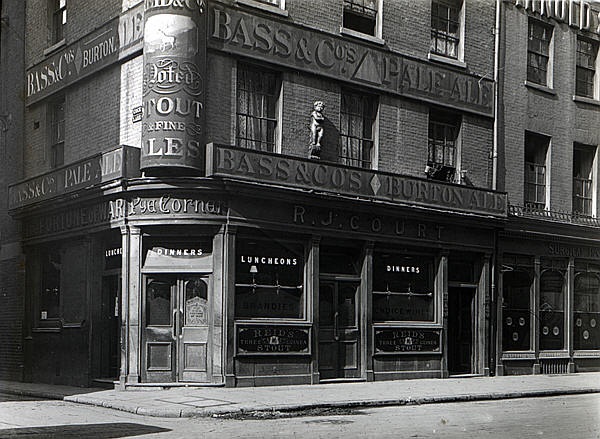
The catastrophe was marked in the eighteenth century by the Fat Boy, a carved wooden figure bearing the inscription ‘This boy is in memory put up for the late Fire of London, occasioned by the sin of gluttony, 1666’. He was put up on the Fortune of War, an inn that stood where Cock Lane meets Giltspur Street, and he survives on the present twentieth-century office building, although in a late-Victorian renovation he became the Golden Boy, and the name Pye Corner was relocated to the Fortune of War.
Once a place of pie-shops, perhaps? This scrag-end of a street shows up surprisingly often in print. According to John Strype it was ‘noted chiefly for Cooks Shops, and Pigs drest there during Bartholomew Fair.’ You might have wanted a strong stomach: ‘Heere is your Cholericke Cooke that will dresse our meate when wee can get any as well as any greasie Scullion in Fleetlane or Pyecorner.’ (William Fennor, The Compters common-wealth, 1617). The place was evidently familiar to theatregoers. Thomas Shadwell in The Woman-Captain (1679) borrows Fennor’s greasy scullion line, while his fellow-fattie Ben Jonson was there first, in The Alchemist (1612):
But I shall put you in minde, Sr. at Pie-Corner,
Taking your meale of steeme in, from Cookes stalls
‘The Great Boobee’ of a seventeenth-century ballad is a gullible countryman undone by carnal temptations:
Next day I through Pye-Corner past,
the Roast meat on the Stall,
Invited me to take a tast,
my Money was but small :
The Boobee gets beaten by the stallholder, then scammed by a ‘gallant lass’ in Smithfield who picks his pocket. ‘An Ancient Song of Bartholomew-Fair’ changes the metaphor (Thomas D’Urfey, Pills to Purge Melancholy, 1719):
At Pye-Corner end, mark well my good Friend,
’Tis a very fine dirty place;
Where there’s more Arrows and Bows, the Lord above knows,
Then was handl’d at Chivy-Chase.
Nobody mentions pies. In Strange newes from Bartholomew-Fair or, the wandring-whore discovered, by Peter Aretine (1661), pretty Peg of Py-corne cries ‘here boys, here’s the best Pigs head in the Fair, a rare quarter of Lamb, pure Mutton, and the best buttock bief in England …’ (she carries on, rather more coarsely than Sid James). The pseudonym Peter Aretine refers to the Renaissance pornographer Pietro Aretino – ‘greasie Aretine’ according to the satirist John Marston in 1598.

We should move on to some other kind of pie. This woodcut is Dutch, but then so was Fennor, probably. St Aelwaer and her donkey are a parody of Dürer’s depiction of Mary in The Flight into Egypt; her bestial emblems of disruption include a pig (for sloth, or gluttony, or vice) and on her head a magpie. This bird has an assortment of attributes; malicious gossip or its benign variant idle chatter would be the relevant one here, for an inn sign. That is a plausible origin of the street-name, although there is no record of an establisment at Pie Corner called the Magpie to confirm it. The pub on the corner of Cock Lane was called the Fortune of War by the early eighteenth century, although at the Old Bailey just down the road the Magpie and Stump was probably so called in the 1500s.
Or piebald horses, perhaps. Thomas à Becket’s clerk William fitz Stephen wrote a description of London in which he gives an enthusiast’s account of a horse fair that was held each Friday on a smooth field (Smithfield) immediately outside one of the the city gates; horses for different purposes were shown to one side or another. Four centuries later, the Agas map includes a mounted horse prancing on the lower part of Smithfield.
That’s not the last of the pies: there was one other in the vicinity. Smithfield, lying just outside the walls on the north-western edge of the old city, had courthouses on both sides, the Old Bailey to the south and the Middlesex sessions-house in St John’s Street to the north. During Bartholomew Fair as at other fairs a summary court would also sit, to adjudicate in trading disputes arising at the fair. They were known as courts of pied poudre or more commonly as Pie-powder courts. ‘The Word is derived from the French Pié a Foot, and Poudre Dust; the Fairs being kept most usually in Summer, to which the Country People use to come with dusty Feet.’ (Guy Miege, The New State of England, 1693).
Before the dissolution the fair with its Pie-powder court belonged to the priory of St Bartholomew. A patent granted by Henry VIII defined Bartholomew Fair as being the fair and markets held within Great St Bartholomew Close and outside it in West Smithfield, and the patent includes the court of Pie-powder held within the said fair and markets. However The Law-French Dictionary of 1701 locates this court inside the close of St Bartholomew the Great, and Strype in 1720 placed it in Cloth Fair; it had probably always been held somewhere within the priory grounds. Pie Corner lay at the tail end of the kite-shaped Smithfield, just outside the priory hospital precinct.
A dusty-footed explanation of the place-name is hard to resist, but the magpie’s claim probably wins. Until the late 1500s the bird was just called a pie, and it has the authority of John Stow, writing in 1598: ‘Pie corner, a place so called of such a signe, sometimes a fayre Inne for receipte of travellers, but now divided into tenementes’.

 Things turned up