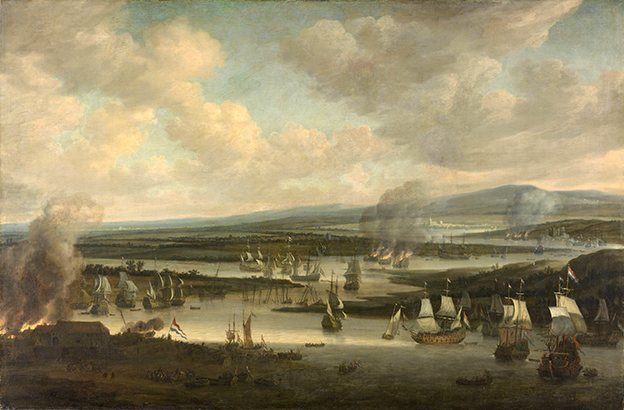
Burning of the English Fleet near Chatham (19–24 June 1667) by Willem Schellinks, 1667–1678 [Rijksmuseum Amsterdam]
An exhibition at Chatham Historic Dockyard in 2017 explored the great naval catastrophe (from the English point of view) or audacious triumph (from that of the Dutch) in June 1667, which ended the second Anglo-Dutch War. The Dutch fleet under admiral Michiel de Ruyter sailed up the Thames and into the Medway, where the English fleet was laid up for lack of cash. They broke through the defensive chain and burned numerous ships, reserving the final humiliation for the English flagship Royal Charles which they towed back home with them. This view of the action by Willem Schellinks (Rijksmuseum, Amsterdam), was not in the show, but there was an impressive array of exhibits from both sides of the North Sea.
When the Dutch scrapped the Royal Charles six years later, they kept the grand ornamental stern carving of the royal arms. It now belongs to the Rijksmuseum, where along with the painting above it was part of their own celebrations of the event. However, it did apparently make a flying return visit to Chatham for the launch of the commemorations there.
I wrote about the Medway raid earlier (here), wondering exactly how they broke the chain, and the Chatham show didn’t quite answer that but it did include a giant iron link from just such a chain. And funnily enough, a small item lent by the British Library happened to pick up the subject of another post a couple of days before this one, on shorthand (here). It’s a notebook kept by Stephen Monteage (1623–1687), whose main claim to fame is as an accountancy expert. In remarks dated ‘about June 12 1667’ on the Medway raid he includes a passage in shorthand. I don’t have an illustration, and as far as I know it has not been deciphered, so I have no idea if he had something improper to say about it or was just saving space.
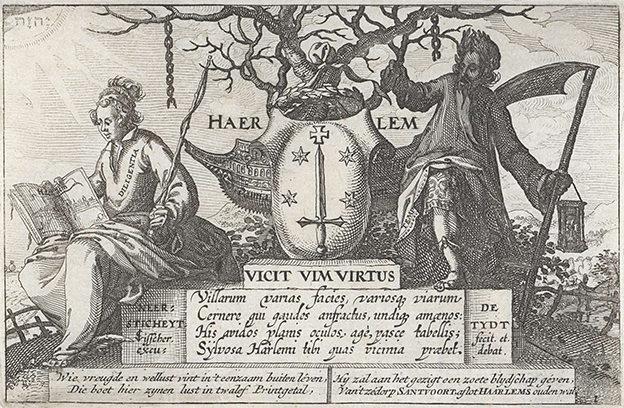
Diligence and Time, by Claes Jansz. Visscher II, early 17th century [Rijksmuseum, Amsterdam]
My previous post was very long – to compensate, here’s a short one. This image once accompanied a set of rustic views around Haarlem. It also contains an unexpected clue about something else entirely, that’s bothered me for a while.
The raid on Chatham on 12 June 1667, in which the Dutch under admiral De Ruyter set fire to the English fleet in the Medway and carried away the Royal Charles flagship, made an appearance in the previous post. Apart from the disastrous decision to lay up the fleet in wartime, the undoing of the English was their reliance on a barricade of sunken ships, and then the chain. This was a well-established harbour defence: an iron chain suspended across the entrance to a river, which attacking ships could not cross. But the Dutch ships did: they broke the Medway chain. The question is, how?
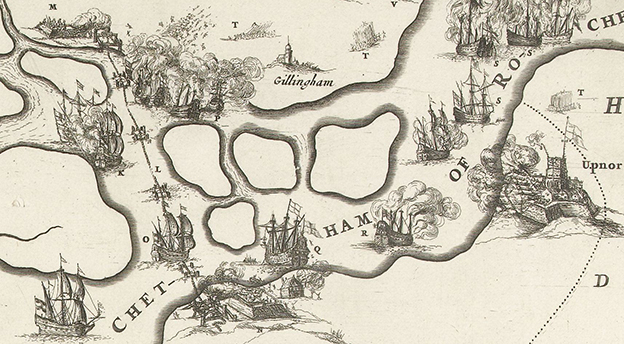
Map detail showing the raid on Chatham, Michiel Comans II, 1667 [Rijksmuseum, Amsterdam]
This is one of an array of maps and illustrations that were published in Holland soon after the raid, some more plausible than others, here showing a fireship breaking the chain. Some have dramatic accounts of the action printed underneath – my grasp of 17th-century Dutch is hit-and-miss to say the least, but the gist of the stories is that the attacker simply sailed courageously through the chain. Fireships were smallish, light and fast, usually cheap conversions of old ships, suggesting speed was the key. One Dutch account mentions a following wind. The day before the attack it was predicted at Rochester that the Dutch would attempt something the next day at noon, when the tide would give them an advantage. A sober report from a surgeon at Chatham, who may have been an eyewitness, says that several fireships got past the wrecks, and the chain was broken by the number of ships pressing on it.
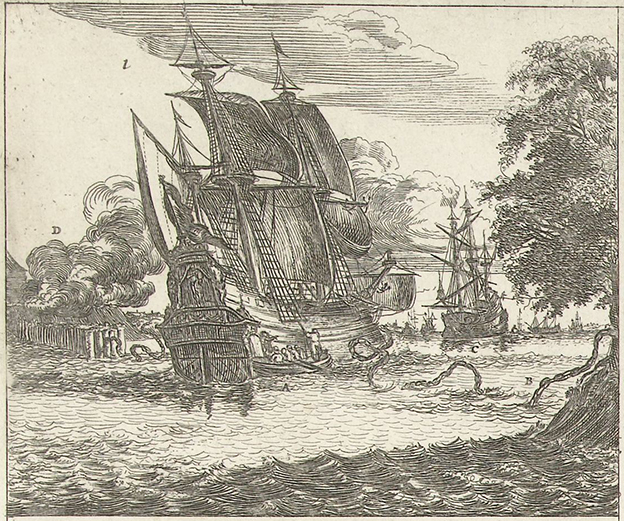
Scene from the Chatham raid by Romeyn de Hooghe, 1667 [Rijksmuseum Amsterdam]
A rising tide would have lifted the Dutch ships over the wrecks and propelled them up the river. This view of a single fireship breaking the chain may be dramatised, but it does also illustrate the final part of the operation. The crew are exiting through a purpose-made door low down at the stern to escape in a boat, leaving the fireship on a collision course with an English ship.
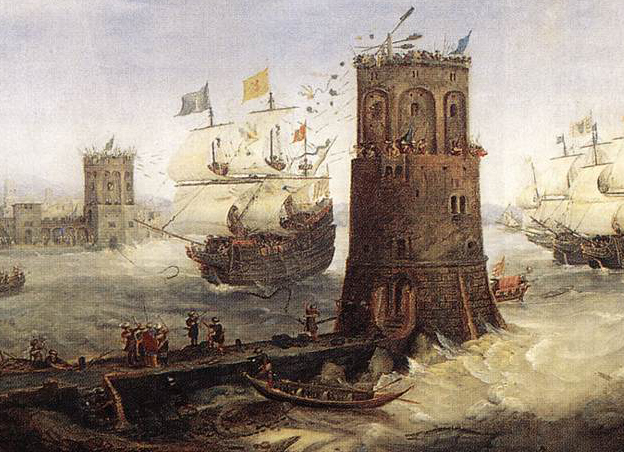
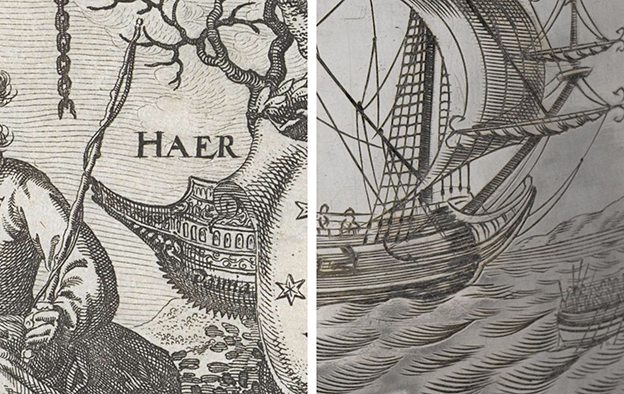
Haarlemmers claimed a further Dutch advantage, in ship design. The painting below depicts the capture of Damietta (Domyat on the Nile delta) during the Fifth Crusade in about 1219; the crusaders’ ship is cutting the chain between the two towers. And in the Visscher print, behind the city’s coat of arms the celebrated feature of that ship can be seen: a saw-toothed keel.
Detail from The capture of Damiate by Cornelis Claesz. van Wieringen, before 1628 [Frans Hals Museum, Haarlem]
I have found no mention of saw teeth in any of the Chatham accounts, and the silver beaker awarded to the captain of the Pro Patria, judged to have broken the Medway chain, has a portrait of his ship showing what looks like a reinforced iron keel extending up the bow, but no teeth. Who knows if a toothed keel would actually work? Perhaps it was more like a rasp. The text accompanying de Hooghe’s illustration proclaims (in my approximate translation): ‘the courage and resolution of the present-day Batavians is no less than that of our forefathers before Damiata’. The nearest I can get to the truth is that a flotilla of fireships sailed at the Medway chain, it broke, and the first past the post got the prize. There was initial confusion over which ship that was, and even an English rumour that the chain had been secured with cable yarn. Real or not though, the saw-toothed keel is an inspired idea. Hard to fathom why captain Jack Sparrow never thought of it.
Left, detail of the Visscher print above. Right, detail of engraved beaker, 1668 [Rijksmuseum, Amsterdam]
 Things turned up